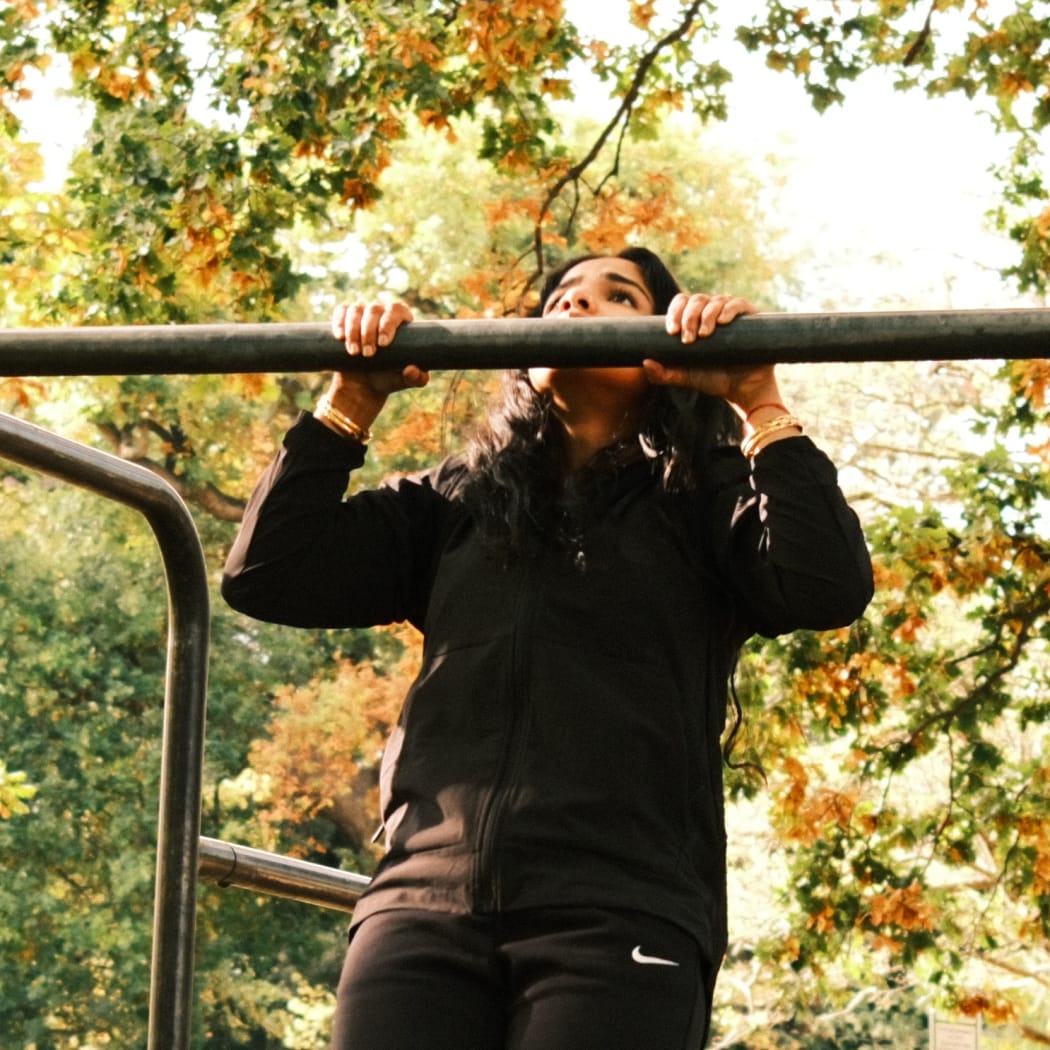
Most people train pull-ups the same way for years: a few sets, stop when it gets ugly, repeat. Then they wonder why they have been stuck at eight reps since spring. Pull-up maxing is the fix for that. It means working on one clear target, your best number of clean reps in a single set, and building your training around it.
What pull-up maxing actually means
The phrase gets used for two different things, and it helps to separate them.
The first is max reps: how many strict pull-ups you can do in one set with no rest. If you hit 12 and then your arms give out, 12 is your max.
The second is max weight: the heaviest load you can pull for a single clean rep, usually by hanging a plate or kettlebell from a belt. Lifters call this a weighted pull-up one-rep max.
Both count. A beginner chasing a first rep or a first set of ten is working on the first kind. Someone who already does 15 and wants to get stronger is better off with the second. Plenty of people do both at different points of the year, and that is a sensible way to train.
What ties them together is the approach. You pick a number, test it honestly, then train in a way that moves that number. No more random sets until you are tired.
Set your rep standard first
Before you test anything, decide what a rep is. This is the part people skip, and it makes their numbers useless. If you count a half rep today and a full one next month, your progress is imaginary.
Here is a standard that works for almost everyone:
- Start from a dead hang. Arms fully straight, shoulders relaxed but not shrugged up to your ears.
- Pull until your chin clears the bar. Not your nose, not your forehead. Chin over the bar.
- Lower all the way down. Elbows straight at the bottom of every rep.
- No kipping and no knee drive. A little body sway is fine. Swinging to build momentum is not.
- Pause briefly at the bottom. A one-second settle stops you from bouncing out of the stretch.
Film yourself from the side the first time. It is humbling. Most people discover their “12 reps” are really eight good ones and four that would not pass a gym buddy’s inspection. That is fine. Eight is a real number, and real numbers go up.
How to test your max
A max test is not a workout. Treat it as a short, focused event.
- Warm up for 8 to 10 minutes. Arm circles, scapular pulls (hang, then pull your shoulder blades down without bending your elbows), and two or three easy sets of two to three reps.
- Rest 3 minutes. You want to be fresh but warm.
- Do one all-out set to the standard above. Stop when the next rep would not meet it, not when you feel like quitting.
- Write down the number along with the date, your bodyweight, and how you slept. Those details help later.
Test no more often than every four to six weeks. Testing weekly wears you down and tells you little. A max is a snapshot, and training is what changes it.
Can’t do one yet? Your max is zero, and that is a perfectly good starting point. Work on slow negatives (jump or step to the top, then lower for five seconds), band-assisted reps, and inverted rows. Most people go from zero to a first strict pull-up in six to twelve weeks of regular practice.
Why your number stops going up
When a max stalls, the cause is usually one of four things.
You only ever train to failure
Going to failure on every set feels productive. It also piles up fatigue fast and makes your reps sloppier as the set goes on. Your back, forearms, and elbows pay for it by the end of the week. Stopping one or two reps short of failure on most sets lets you do more total quality work, and more quality work is what builds strength.
You don’t train often enough
Pull-ups are a skill as much as a strength exercise. Your nervous system gets better at them through frequent practice. Doing them once a week means you spend half of every session relearning the movement. Two to four exposures per week, with lower volume each time, tends to work far better.
Your bodyweight is working against you
This one is awkward to talk about, but it matters. If you gain five kilos and your strength stays the same, your pull-up max drops. Likewise, a small drop in bodyweight can add a rep or two without any extra training. You do not need to be lean to be good at pull-ups, but be honest about how weight affects the number.
Your weak link is not where you think
Some people stall because their grip gives out first. Others lose their lats at the sticking point, or their elbows ache and they back off. Figure out which one you are. If you fail because your hands open, grip work will help. If you fail halfway up with your hands still gripping, you need more pulling strength.
Four ways to add reps
You do not need all of these at once. Pick one or two, run them for a few weeks, and see what happens.
1. Grease the groove
This method comes from the strength coach Pavel Tsatsouline. The idea is to do many easy sets spread across the day, each one well below your limit. If your max is 10, you might do sets of four or five, several times a day, with no burn at all.
It works because you are practicing the movement fresh, over and over, without building fatigue. It suits people who have a bar at home or at the office. A typical day could be five sets of 4, with at least an hour between them. Do this three or four days a week and give yourself a day or two off.
2. Ladders and clusters
A ladder goes like this: 1 rep, rest, 2 reps, rest, 3 reps, rest, then back to 1 and climb again. Rest only as long as it takes to shake out your arms, about 30 to 60 seconds. You can hit 20 to 30 total reps without ever grinding.
Clusters are similar. Say your max is 8. Do 5 reps, rest 20 seconds, do 3 more. Then rest two minutes and repeat. You are collecting reps at a quality you could not hold in a straight set.
3. Sub-max volume
Take your max, cut it roughly in half, and do multiple sets of that number with 90 seconds to two minutes of rest. A person with a max of 10 would do six sets of 5. When that feels easy, add a set, or shorten the rest by 15 seconds. It is basic, and it works because it builds work capacity without frying you.
4. Weighted pull-ups
Once you can do around 10 strict reps, adding weight is the most efficient way to keep getting stronger. Use a dip belt or hold a dumbbell between your feet. Start light, with 2.5 to 5 kilos, and work in sets of three to five reps. When all sets feel smooth, add a little more.
Here is why this helps your rep max: if you can pull your bodyweight plus 20 kilos for a few reps, your bodyweight alone feels light. Many people who add 10 kilos to their pull-ups find their unweighted max jumps by three or four reps within two months.
An 8-week plan
This plan assumes you can do at least 5 strict pull-ups and want to build toward 10 or more. If your max is lower, shrink the rep numbers. If it is higher, add weight in the “strength” session. Train on non-consecutive days, for example Monday, Wednesday, and Friday.
| Day | Focus | What to do |
|---|---|---|
| Day 1 | Volume | 6 sets at about half your max, resting 90 seconds. Example: max of 10 means 6 × 5. |
| Day 2 | Strength | 5 sets of 3 reps. Add weight so the last rep of each set feels hard but clean. Rest 2 to 3 minutes. |
| Day 3 | Practice | One ladder (1-2-3-4, then back down) and 3 to 4 easy extra sets of 3 to 4 reps later in the day. |
Weeks 1 to 3: Run the table as written. Each week, add one set to Day 1 or one extra rung to the ladder.
Week 4: Cut everything by about a third. This is a lighter week so your tendons and nervous system catch up. Do not skip it.
Weeks 5 to 7: Go back to full volume, then increase the weight on Day 2 by a small amount each week. Even a single kilo counts.
Week 8: Take two easy days, then test your max. Use the same warm-up and the same rep standard you used at the start.
Many people add two to four reps over a cycle like this. Some add more, especially if they started with sloppy form and cleaned it up. Others add one, which is still good if your starting number was already high.
Protect your elbows and shoulders
Pull-ups load the elbows and shoulders more than you might expect, and tendons adapt more slowly than muscle. That mismatch is why so many keen lifters end up with sore elbows right when their strength is climbing.
- Vary your grip. Rotate between pronated (overhand), neutral, and supinated (chin-up) grips from block to block. Different grips share the load across different tissues.
- Add some pushing. Push-ups and overhead presses balance out all the pulling, and they keep your shoulders happier.
- Do not hang on dead joints. Start your pull by setting your shoulder blades down and back slightly, rather than hanging passively from the ligaments in your shoulder.
- Back off if pain is sharp or lingering. A dull pump is normal. A pinch you can point to with one finger is not. Reduce volume for a week, switch grips, and see a physio if it persists.
Common mistakes
Chasing reps with half-range
If your reps do not go to a full hang, you are training a different, easier exercise. Your max will look good on paper and collapse the moment you test it properly.
Doing too many sets too soon
More is not always better. A beginner who jumps from 10 sets a week to 40 will often end up with sore elbows and no extra reps. Add volume slowly.
Ignoring rows and other back work
Pull-ups are great, but they are not the only thing your back wants. A couple of sets of rows or face pulls each week help your upper back and rear shoulders, and give your elbows a break from vertical pulling.
Never resting enough
If your reps are slipping week after week, you are probably not recovering. Sleep, protein, and a lighter week every fourth or fifth week fix more stalls than any clever program.
Testing too often
Maxing out every few days is a good way to feel strong and train poorly. Test at the end of a block, then go back to building.
Questions people ask
How many pull-ups is a good max?
For an average adult man, five to ten strict reps is solid, and 15 or more is strong. For women, one to five is a respectable range for most people who do not train pulling, and 8 to 10 is excellent. These are rough guides, not rules. Your body, age, and training history matter more.
Is it better to use an overhand or underhand grip?
Chin-ups, with your palms facing you, are usually a little easier because your biceps help more. Overhand pull-ups lean harder on your lats and forearms. Train both, and test the one you care about most.
How often should I train pull-ups?
Two to four times a week suits most people. If you do grease-the-groove style sets, you can do more days, but keep each set easy.
Can I do pull-ups every day?
You can, if the volume is very low and nothing hurts. Most people do better with at least one or two rest days a week, especially once they start adding weight.
Do I need to lose weight to get more pull-ups?
No, but lighter bodyweight makes every rep easier. If you are carrying extra fat and want a higher number, a modest drop can help alongside training. Do not crash diet, though. Being under-fuelled hurts strength more than it helps.
How long until I see progress?
Beginners often add a rep or two within two to three weeks. Intermediate lifters might need four to eight weeks for the same gain. The closer you get to your limit, the slower it moves.
Final thoughts
Pull-up maxing is not complicated. Decide what counts as a rep, test honestly, train a few times a week without going to failure every time, add weight once you are ready, and give yourself a lighter week now and then. Then test again and write the number down.
The people who get good at pull-ups are not the ones with perfect programs. They are the ones who keep showing up to the bar and keep their standards the same. Pick your starting number, run the eight weeks, and see where you land.
A quick note: this article is general fitness information, not medical advice. If you have an existing injury or pain in your shoulders, elbows, or wrists, check with a doctor or physiotherapist before starting a new program.