President Donald Trump has turned down a seven day ceasefire proposal from Iran and has privately told his advisers that he expects American bombing of the country to resume once the November midterm elections are over, according to a report published this weekend by the Wall Street Journal and confirmed by multiple outlets citing U.S. officials.
The rejected proposal came from Iranian Foreign Minister Abbas Araghchi, who had offered a plan under which Tehran would reopen the Strait of Hormuz and return to the negotiating table over its nuclear program. In exchange, the United States would have needed to agree to a series of conditions, including lifting its naval blockade of Iranian ports, waiving sanctions on Iranian oil sales, and observing a ceasefire that would extend to Lebanon. Araghchi said his government had already passed the plan to Washington through intermediaries and that it could be put into effect as soon as the American side accepted the terms. India TV News
Trump was not interested. According to the Journal’s sourcing, the president has turned down Tehran’s proposal and expects the bombing campaign in Iran to pick back up after the midterms. Reuters noted it had not been able to independently verify the Journal’s account, a caveat worth keeping in mind even as the report spread quickly across other outlets. Yahoo!
What makes the story notable is not just the rejection itself but what it suggests about Trump’s private thinking. Officials say that although Trump has said publicly that Tehran is desperate for a deal that would dismantle its nuclear program once the midterms are behind him, privately he doubts Iran would actually agree to his terms and has told his own staff that another round of bombing looks like the more likely outcome. The same officials cautioned that his position could still shift as the war drags on and possibly depending on how Republicans perform at the ballot box in November. Just how heavy any renewed campaign would be has not been determined. MSNMSN
This is not the first time Trump has floated the idea of an even more drastic escalation. He has previously announced the possibility of massive strikes as a way of breaking diplomatic deadlocks with Iran, sometimes acting on those threats and other times pulling back from the most extreme version of them. MSN
To understand why a ceasefire offer is even on the table, it helps to look back at how this conflict escalated in the first place. The current war traces back to American strikes in June, when the United States hit what the administration described as Iran’s central nuclear facilities in an operation officials called Midnight Hammer. In a prime time address to the nation from April, Trump framed the campaign as the fulfillment of a promise he said he had made since launching his first presidential campaign in 2015: that Iran would never be allowed to build a nuclear weapon. He credited the strikes with crippling Iran’s navy and argued the operation had denied Tehran the ability to build a bomb, while acknowledging that thirteen American service members had died in the fighting.
Independent assessments have complicated that narrative somewhat. Weapons inspectors have said Iran could likely resume enrichment on a smaller scale within a matter of months despite the damage to its sites, a point that has fed into the argument, made by critics of the administration, that the military campaign bought time rather than a permanent solution.
The war has also drawn scrutiny on human rights grounds. Just days before Trump’s speech to the United Nations last week, a UN fact finding mission said it had found reasonable grounds to believe that American strikes, including one that hit a primary school in the southern Iranian city of Minab, may have amounted to war crimes. That finding has not stopped the administration from continuing to press its case that the campaign was necessary and effective.
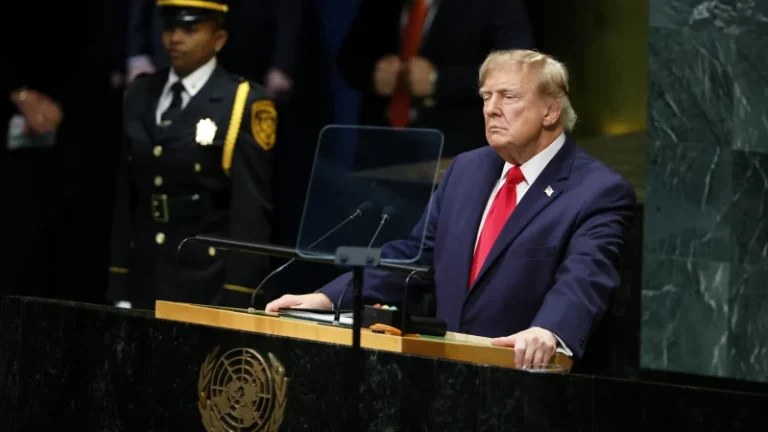
Trump used his September 22 address to the UN General Assembly to lay out the choice he says he is weighing. Speaking to world leaders in New York, he framed the decision in stark terms, saying he had to decide between striking a deal that would let Iran rebuild into what he called one of the greatest countries in the Middle East, or moving to what he described as annihilating the Islamic Republic and driving it into what he called hell with no hope of recovery. He told the assembled delegates he did not expect an agreement to be reached before the midterms, adding that Tehran was waiting to see how his party performed at the polls. He insisted that domestic politics would not factor into his decision making on Iran, saying the only consideration that mattered to him was ensuring Iran never obtains a nuclear weapon.
The speech also touched on broader themes, with Trump using the venue to press countries to join the United States in isolating Iran economically in order to force further concessions. He devoted part of his remarks to defending the strikes as having spared the world a nuclear armed adversary, even as he acknowledged Tehran continues to insist its program is for civilian purposes only. Iran has repeatedly denied it is seeking nuclear weapons.
Behind the scenes, Trump has reportedly grown more skeptical that talks are worth pursuing at all in the near term, telling aides at points that negotiations have been a waste of time while his administration leans harder on sanctions and on efforts tied to reopening the Strait of Hormuz, the narrow waterway that much of the world’s oil shipping passes through and that Iran has used as leverage throughout the conflict.
On the Iranian side, officials have pushed back on the American framing of events. Speaking to Fox News, Iranian President Masoud Pezeshkian placed blame for the collapse of an earlier negotiated framework, one both sides had reportedly reached back in June, on the United States. He argued that rather than pursuing dialogue, Washington had chosen to escalate militarily first and had blocked diplomatic avenues from opening. Araghchi, for his part, has suggested that any deal would be far preferable if it could be reached before the midterm election rather than after, an indication that Tehran may see the American political calendar as a closing window for a less costly settlement.
The dispute over the ceasefire proposal is unfolding against a backdrop of domestic political pressure on Trump. Recent polling cited by NBC News found that a majority of registered voters, 56 percent, disapprove of the way the president is handling his job, with 55 percent saying they believe his policies are hurting the economy. That kind of polling adds a layer of complexity to any suggestion that Trump is simply waiting out the midterms before making his next move, since a poor showing for his party at the ballot box could theoretically change his calculus on how aggressively to proceed with Iran, even though he has publicly insisted the election plays no role in his thinking.
There is also a pattern here that watchers of the conflict will recognize. Trump has a history of issuing maximalist threats against Iran only to step back from the most extreme options while still following through on more limited strikes. Back in April, he warned in a social media post that, in his words, an entire civilization would not survive the night, a statement that drew condemnation from human rights groups and unsettled even some of his usual allies, who worried aloud about the implications of that kind of rhetoric attached to the world’s largest nuclear arsenal. That moment passed without the apocalyptic outcome the post implied, and the pattern of threat followed by partial de escalation has repeated itself since.
Whether this latest rejection follows that same script or marks a genuine turning point toward renewed bombing is something that will likely become clearer only in the weeks ahead. For now, the specifics of any future campaign remain undefined. Officials briefed on the discussions say the scope, timing and intensity of a possible new round of strikes have simply not been decided, and that Trump’s own position could evolve depending on how events unfold between now and the midterms on November 3.
In the meantime, the practical effects of the ongoing standoff continue to be felt well beyond the negotiating table. The naval blockade the United States has maintained around Iranian ports has added further strain to an economy already under heavy sanctions pressure, with reports suggesting ordinary Iranian families are beginning to feel the pinch through rising costs for energy and food. That economic squeeze is very likely part of what is driving Tehran’s interest in a ceasefire in the first place, even on terms that would require significant concessions from Washington in return.
For now, the war sits in a kind of limbo. Diplomatic channels remain technically open, given that Araghchi’s proposal was transmitted through intermediaries and Iran continues to signal interest in a deal. At the same time, the administration’s rhetoric, from the UN podium to private conversations with aides, points toward a White House bracing for the possibility that talks go nowhere and that American bombs start falling on Iranian territory again once votes are counted in November. How Congress, allied governments and Iran itself respond to that prospect over the coming weeks will likely shape whether this moment is remembered as the point where a wider war resumed, or another instance of Trump pulling back from the brink he keeps describing in public.
Given how fast this story is moving, and that Reuters has flagged it as not yet independently verified, treat the specifics as still developing. If you’d like, I can also turn this into a downloadable file, or keep tracking updates as more outlets confirm or add detail.