There are speeches that make headlines because of what a president promises. And then there are speeches that make headlines because of what a president wonders out loud. This week’s address to the United Nations General Assembly falls firmly into the second category, and it’s the kind of moment commentators have been picking apart ever since.
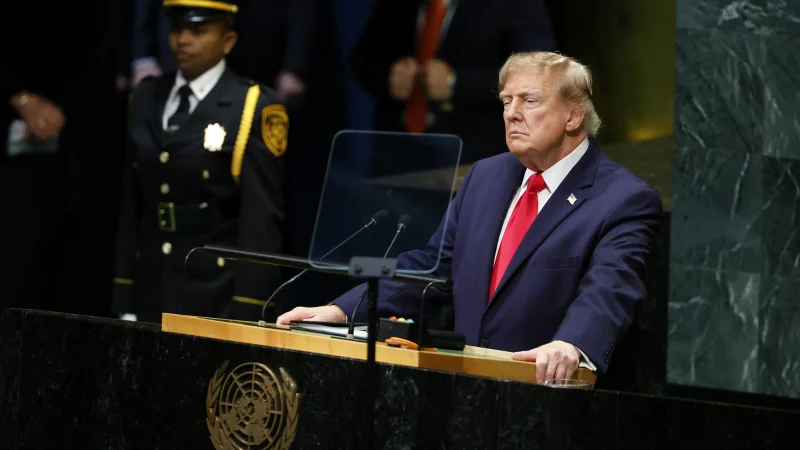
Speaking to the General Assembly, President Trump told the room he had been weighing two paths with Iran: making a deal, or something far darker. He put it to the audience almost as a private thought spoken aloud — asking himself, in front of the world, whether he should push the country toward total destruction, with nothing left afterward and no future for its people. It’s the kind of line usually reserved for a translated fragment from an ancient conqueror’s tablet, not a sitting American president standing behind the blue-and-white U.N. podium.
That’s exactly the observation NPR’s Scott Simon made in a recent essay: it isn’t so much what Trump was proposing that stood out, but how openly he chose to say it. As Simon put it, words like that land with extra weight coming from someone with the actual power to send troops into motion and missiles into the sky — this isn’t hypothetical talk from a pundit, it’s coming from the one person on Earth who could actually order it done.
A Long Line of Careful Words
To understand why this moment felt so jarring, it helps to look back at how American presidents have historically talked about their most terrifying military capabilities — because there’s a long, fairly consistent pattern, and Trump’s remarks broke from it sharply.
Start with the most obvious historical parallel: Harry Truman, in August 1945, announcing to the world that the United States had just dropped an atomic bomb on Hiroshima. That bombing killed an estimated 70,000 people instantly, with roughly 40,000 more dying in the following days in Nagasaki, and tens of thousands more over the following months and years from radiation sickness. It remains, by any measure, one of the most devastating single acts in the history of warfare.
And yet, when Truman announced it, he didn’t reach for triumphant or menacing language. He described the bomb as something closer to a scientific milestone — a harnessing of the fundamental forces of the universe — and he coupled the announcement with warnings about the danger of sudden destruction, framing the moment with something closer to solemnity than swagger. It was an admission of enormous, terrible power, delivered in restrained, almost clinical language.
That pattern continued for decades. When John F. Kennedy ordered the naval blockade of Cuba in 1962 — arguably the closest the U.S. and Soviet Union ever came to actual nuclear war — he didn’t posture about annihilation either. Kennedy told the American public the country would not needlessly gamble with the possibility of global nuclear war, warning that even a “victory” in such a conflict would taste like ashes. It’s a strikingly humble thing for a president to say in the middle of the most dangerous standoff of the Cold War: that winning such a war wouldn’t even feel like winning.
Gerald Ford, addressing the United Nations in 1974, continued in that same restrained register. Across administrations, Republican and Democratic alike, there’s a consistent thread: American presidents, even while holding the largest nuclear arsenal on the planet, have tended to talk about that power the way a person might talk about a fire extinguisher behind glass — acknowledging it exists, hoping never to need it, and being careful not to describe, in any detail, what happens if the glass breaks.
Why the Contrast Matters
This is really the heart of Simon’s essay: it’s not just that Trump discussed the possibility of devastating Iran. It’s that he discussed it the way someone might describe a hypothetical scenario in a debate club, rather than the way his predecessors — going back eight decades — have handled similar rhetorical territory. Where Truman spoke of scientific gravity, Kennedy of unwanted sacrifice, and Ford of measured diplomacy, Trump’s framing sounded almost conversational: laying out the options, weighing them out loud, in front of the entire world.
To Simon and others who share his read on the moment, that departure isn’t a small stylistic quirk — it’s a break in a kind of unspoken rulebook that’s guided how American leaders talk about the ultimate use of force. Whether or not any president actually intends to follow through on such rhetoric, the argument goes, the choice of words itself carries meaning on a world stage — allies and adversaries alike parse it, weigh it, and factor it into their own decisions.
The Other Side of the Argument
It’s worth noting, in fairness, that this isn’t a view every observer shares. Supporters of the president’s approach to foreign policy have long argued that Trump’s blunt, unpredictable style of rhetoric is itself a deterrent — that adversaries take unambiguous, forceful language more seriously than diplomatic hedging, and that decades of “restrained” presidential language didn’t exactly prevent conflicts, wars, or nuclear proliferation either. From that vantage point, plain talk about worst-case options is read not as recklessness but as clarity: telling an adversary exactly what’s on the table, rather than leaving it to guesswork.
Whether one reads the U.N. remarks as dangerously loose talk or as calculated toughness likely depends a great deal on one’s broader view of this administration’s approach to foreign policy generally. What’s less disputed is the historical point Simon’s essay rests on: American presidents, across seventy-plus years and multiple parties, have tended to talk about the worst tools in their arsenal with notable restraint, even in moments of genuine crisis. This week’s remarks were, by that historical yardstick, an outlier.
What Happens Next
For now, the speech is what it is — a moment that will likely be replayed, quoted, and debated for a while, both by Trump’s critics and his defenders, each reading the same eleven seconds of remarks through a very different lens. Whether it produces any tangible shift in policy toward Iran, or fades into the long list of Trump rhetorical moments that generated headlines without changing outcomes, remains to be seen.
What does seem clear is that this speech will be remembered as a data point in the broader conversation about how presidential rhetoric has changed — not just under this administration, but as a marker of how far the boundaries of “normal” presidential language have shifted since the more careful, guarded era of Truman, Kennedy, and Ford.
This piece draws on and responds to Scott Simon’s opinion essay for NPR, “Trump’s U.N. speech, a stark contrast with past presidents,” published September 26, 2026.